
God saves us, not because of any works of righteousness that we had done, but according to his mercy, through the water of rebirth and renewal by the Holy Spirit. —Titus 3:10
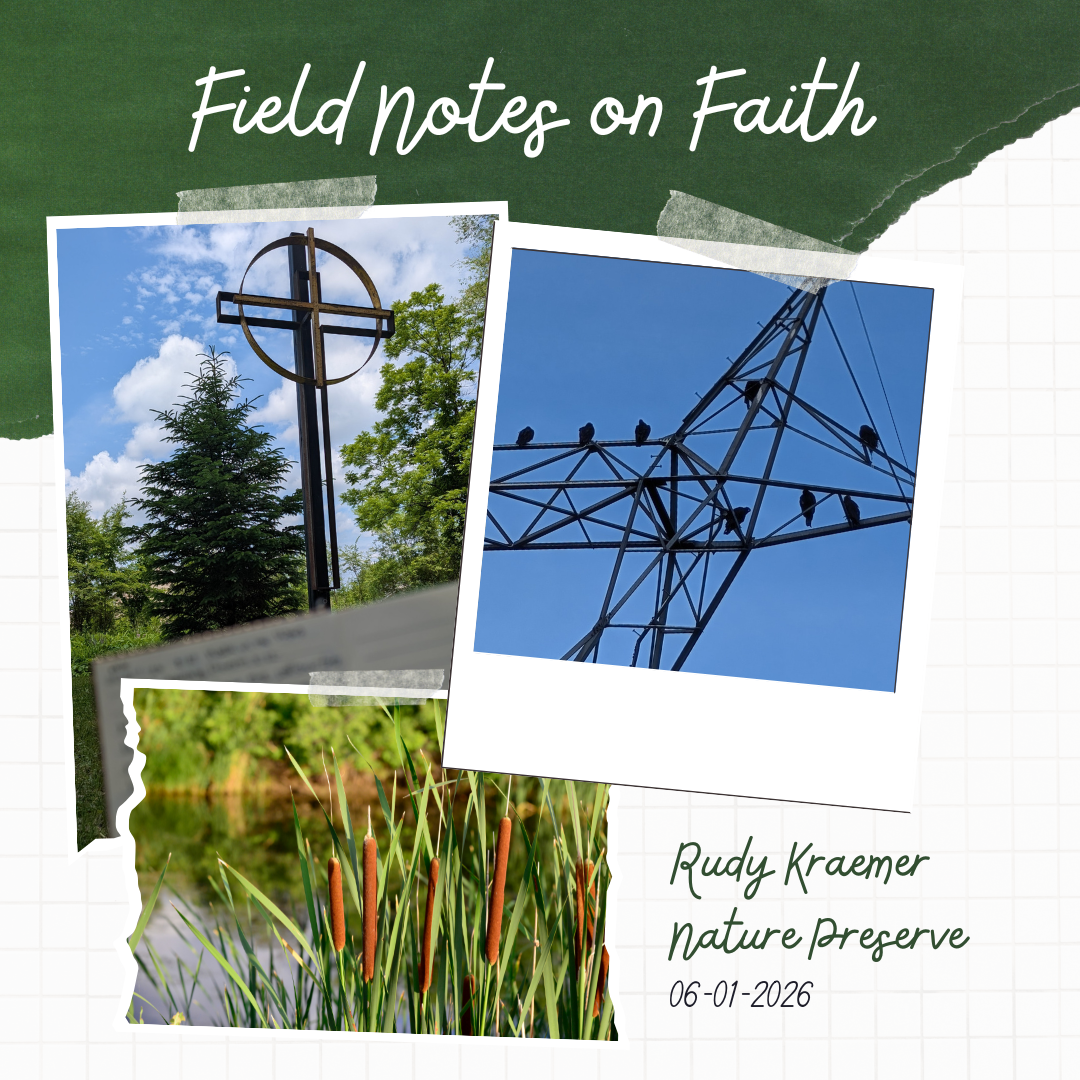
My Field Notes 6/1/2026, 7:09 am, Rudy Kraemer Nature Preserve:
Curious call coming from a willow tree; Merlin identifies as a cat bird—Is that sweet grass I smell?—Washed up wriggling worm, moved safely to the grass—Colony of invading poison ivy—Wetlands = nature’s sponge—Stories and memories shared of a father who died; his legacy walks beside me—Plopping rocks in water spreading ripples across—Thudding feet on a wooden bridge scatter schools below—Turkey vultures congress on towers of power—Auburn rusty colored cattails stand tribute to last year—Chrystal dew drops cling to sedge leaves—DON’T STEP IN THE POOP—Race you to the top.
I love exploring nature on my own, taking time to notice the small details and admire God’s diverse handiwork. When I walk with others, I don’t have the leisure to stop and identify everything I want to, and yet, when I walk with others my perspective opens wider and deeper. When I am drawn to the path through the trees, others want to see the visitors center. There I learned wetlands are nature’s “sponge.” The Rudy Kramer Nature Preserve is an integral part of the watershed from other lakes, ponds, and city water runoff from Burnsville—including our church and neighborhood. The wetlands filter out debris, chemicals, and toxins before the water passes into the Minnesota River, delivering cleaner, purer water for those downstream.
Above our heads on the electrical towers were over two dozen turkey vultures. Uh-oh, what died? I have always thought vultures were an omen of death, but when I searched for the symbolism of this carrion, I learned turkey vultures symbolize transformation, purification, and renewal. They are natures "clean-up crew," eating dead, even diseased animals. Both the turkey vultures and the wetlands are essential to a healthy and thriving ecosystem. They are revered for their ability to turn decay into new life.
Is that not like our God? Who takes symbols of death, most notably the cross, and transforms it into symbols of life? Who breathes on us the purifying Holy Spirit so we may daily be renewed?
Surely, God is in this place!
God is in our backyard purifying water so it may nourish rather than harm. God is in the sky descending and consuming what is dead so that life may flourish.
Surely God is in this place. May it be known.
Yours in Christ,
Pastor Jenny
Faith Practice: Seeing God
Martin Luther talked about God being hidden in ordinary things, calling them the larvae dei or the “masks of God.” Consider an element of nature that you do not like or you think is gross. Observe it if you can. Research its behavior and purpose. Reflect on how God might be in this part of nature too.