
Then the Lord God formed man from the dust of the earth and breathed into his nostrils the breath of life, and the man became a living being….The Lord God took the man and put him in the garden of Eden to till it and keep it. –Genesis 2:7,15
My Field Notes 6/10/2026, 7:32 pm, My Backyard, Apple Valley:
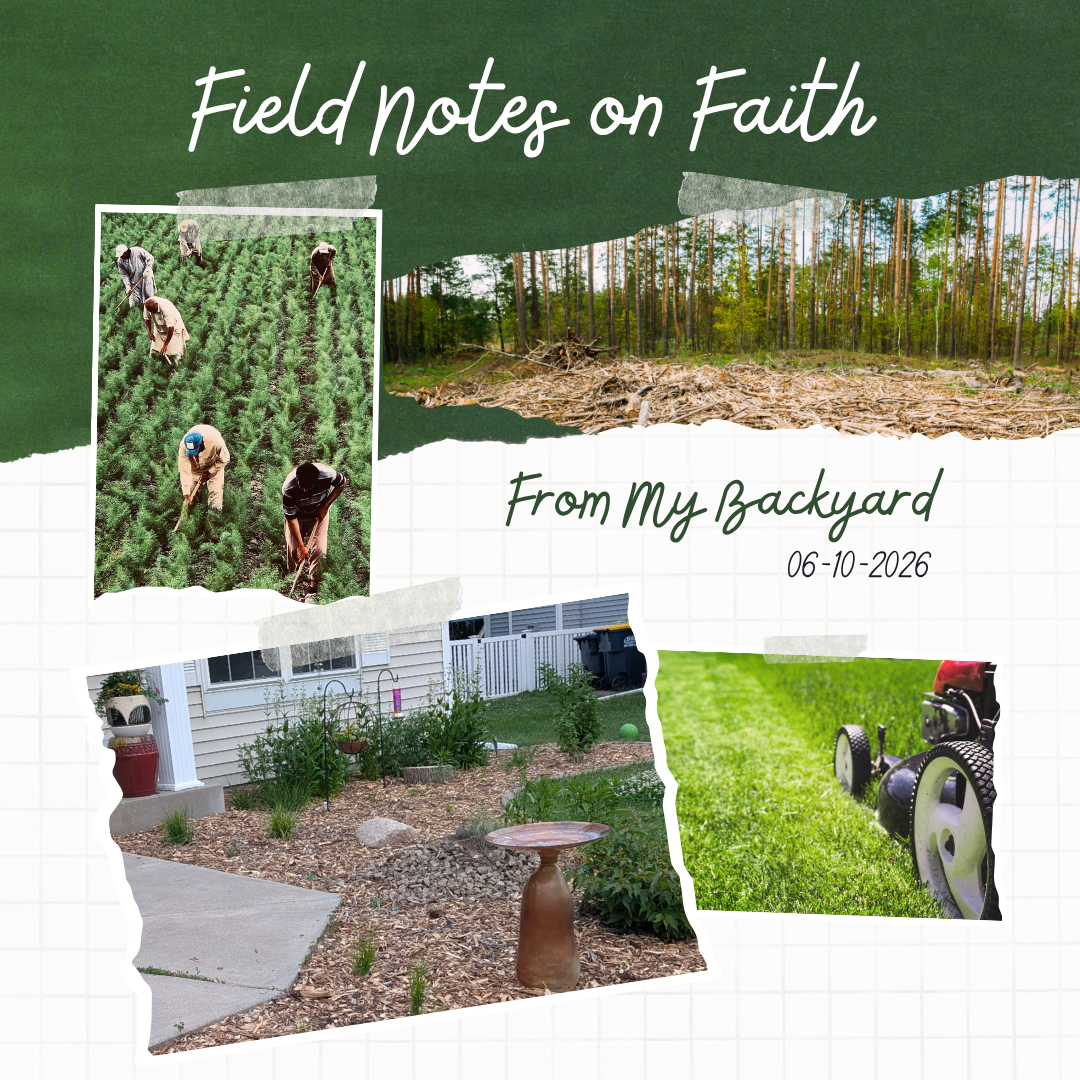
Droning lawn mower engine—yellow dandelions closed until the sun returns—divots of earth beneath my feet—wind whipping my hair into my eyes—maple leaves pat my head when I pass beneath— decapitated dandelions—CLACK, branches splintered beneath the blades—blade of grass swaying in the wind—I leave my mark in neat rows—the grass makes its mark on my stained shoes.
Mowing is often a chore that Peter takes on, but last week I finished a part of the lawn left after the second battery died on our electric lawn mower. It was hot and muggy, but a strong wind made it bearable. As I watched the line, the change from the cut grass to the tall grass, a parable popped into my head. It was the one Jesus told, about a farmer sowing seeds but when everyone slept, his enemy sowed weeds. When the farmer was asked if they should pull up the wheat, the farmer told the workers to leave them until harvest because pulling the weeds would uproot the wheat. I began to wonder if it was better to leave the grass growing. Is it better to cut, trim, and prune or let things grow?
Before I entered seminary, I worked for Boulder County as a forestry team lead in Colorado. Every day I would drive a group of teens into the foothills to lop branches and build brush piles for the fire mitigation crew to burn later. I remember crying the first time I cut down a sapling, taking life rather than nurturing it. But as the summer stretched on, I learned more about the ecosystem of healthy forests, the threat of invasive plants (even pretty ones), and how forest maintenance (even pruning and cutting down) promotes the health of the whole. That summer I also came home every day sweaty, aching, and covered in pine sap.
Fast forward many years. Now as a pastor, I carry different aches in my body and in my heart. I drive into work and turn up the air conditioning when I get there. I no longer carry loppers and often cannot see the efforts of my labor in piles of brush and that is why I garden. There is satisfaction in physical labor. Our bodies remind us of what we are capable of—and not capable of. Digging in the dirt, reminds us of where we came from “from dust we came and to dust we shall return.” Can you imagine God scrapping and shaping earth into a human form? Can you imagine God with dirt under his divine nails? Can you imagine God aching after laboring with creation? Resting and stretching out the aches? Can you imagine God carrying aches in their heart today?
I am acutely aware that the physical labor I do is by choice. I have stable employment and time that enables me to work in my backyard. I have a body that enables me to labor—for now. Others labor not by choice but out of necessity. It may be the only work they can find. For others, they labor to survive—carrying water, caring for animals, tending vegetables or crops. When I cut grass or bend down to pull weeds, I am reminded I am as human as they are, all of us dusty creatures. When I labor, I become more connected—to the earth, to humanity, and to God.
Surely God is in this place. May it be known.
Yours in Christ,
Pastor Jenny
Faith Practice: Physical Labor
In her book An Altar in the World, Barbra Taylor Brown reflects on the ordinary spiritual work of physical labor on her farm from gathering eggs, to hanging laundry on the line, to digging up potatoes.
Try doing something that require extra physical labor. You could mow your yard (or a neighbor’s), volunteer in a food shelf warehouse, help clean the church, or dig up some weeds. When you feel the strain and ache in your body, think about others who labor daily. Think about God laboring over creation in the beginning and in a different way, today. Think about others who labor daily.
If you are unable to do physical labor, think about those who labor on your behalf: those who grow and harvest your food, those who clean, and those who you’ll never meet but who labor for their daily bread. Give thanks to God for their work and pray for their wellbeing.