
God saves us, not because of any works of righteousness that we had done, but according to his mercy, through the water of rebirth and renewal by the Holy Spirit. —Titus 3:10
My Field Notes 6/14/2026, 2:50 pm, Yellowstone National Park, WY:
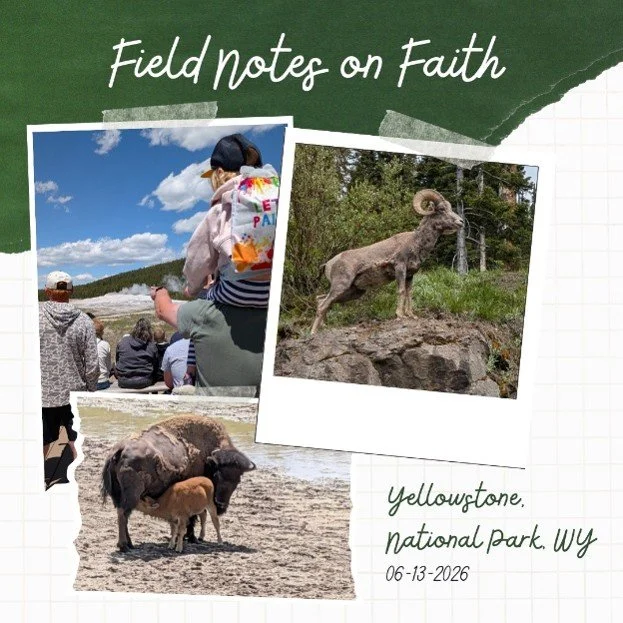
Ribbons of rivers with white capped rapids—Water lines etched in rock like a growth chart of the earth—Towering Buttes stand forlorn like forgotten altars—Grazing bighorn sheep gaze at gawking tourists—fields of sagebrush, a refuge for ground squirrels—billowing steam escaping fumaroles—churning caldrons—crusty bays and stinky steam—waves of water and sound pushed by subterranean thermal pulses—gloopy burbling mini mud volcanoes—bison pie and dried hoof prints—panting bison lounging near a steam vent, are you OK?
Stop the car! It was our first of many stops throughout our visit to Yellowstone National Park. We learned early on, if cars are stopped on the side of the road, the chances of seeing an animal are pretty good. Molly was the one who saw them first. Look up! There, on the rocky overhang by the road were two majestic big horn sheep. Peter pulled out the binoculars, I took a picture on my phone, and Molly recorded the sighting in her journal. This is why we came to Yellowstone, dubbed “America’s Serengeti,” to see wildlife.
We saw herds of bison with newborn calves, trout swimming upstream to spawn, elk grazing in the fields, bald eagle soaring above, marmots playing, ground squirrels scurrying across trails, and even a solitary moose and her calf on our way out of the park. It was incredible seeing wild animals in their natural habitat. I love nature, but even more inspiring to me was seeing my child’s excitement and careful attention to the natural world.
In her book An Altar in the World, Barbra Taylor Brown recalls seeing stars fall from the sky for the first time when she was a child. She was in awe of the great universe. Awe leads to respect and respect leads to reverence:
“Reverence in awe of something—something that dwarfs the self, that allows human beings to sense the full extent of our limits—so that we can begin to see one another more reverently as well. An irreverent soul who is unable to feel awe in the presence of things higher than the self is also unable to feel respect at things lower than the self.”
Reverence led to the creation of National Parks. Explorers, scientists, and politicians recognized the value of protecting land from commercial use and development for the enjoyment of future generations. To think, seven generations later after Yellowstone became the first National Park, my daughter is experiencing the joy and reverence for wilderness because of the decision to protect and preserve this national treasure.
Barbara Taylor Brown also noted that, “Reverence for creation comes fairly easily for most people. Reverence for other people presents more of a challenge, especially if those people’s lives happen to impinge upon your own.”
I’ll admit, I felt much more reverent watching trout in a remote mountain stream than waiting for Old Faithful to erupt along with everyone else. This natural attraction had its own off ramp from the highway. There were people from Arkansa and others from Maine. Wheelchairs and strollers and kids on shoulders. While the heat and mass of people overwhelmed me that day, Old Faithful was a place for ALL people from every conceivable background. What if I paid attention to others the way I paid attention to nature? Perhaps I would become more reverent, honoring God in ALL of God’s beautiful creation.
Surely, God is in this place and this people too. May it be known.
Yours in Christ,
Pastor Jenny
Faith Practice: Paying Attention with Reverence
In Nature: find a place to sit outside for 20 minutes, preferably by a body of water. Pay close attention to your surroundings. The texture and color of the stone. Movement of plants and insects. What do you notice? Give thanks to God.
With People: Pay attention, even for a moment to another person, even when they are in your way. How is their posture? Ask God to help them carry their burdens. What does their voice sound like? What are their movements like? Fast? Slow? Weary? Measured? Pray this way: May they be happy. May they be healthy. May they be whole and at peace.